

How to Find a Qualified Hypnotherapist in Australia (And Why It Actually Matters)
Not long ago I had a discovery call with a woman who had seen a hypnotherapist, done several sessions, and still felt stuck. She was not sure why. It was only when a friend asked whether the person was actually accredited that she realised she had never thought to check.
She had not known to ask. Most people do not, because nobody tells them it is a question worth asking.
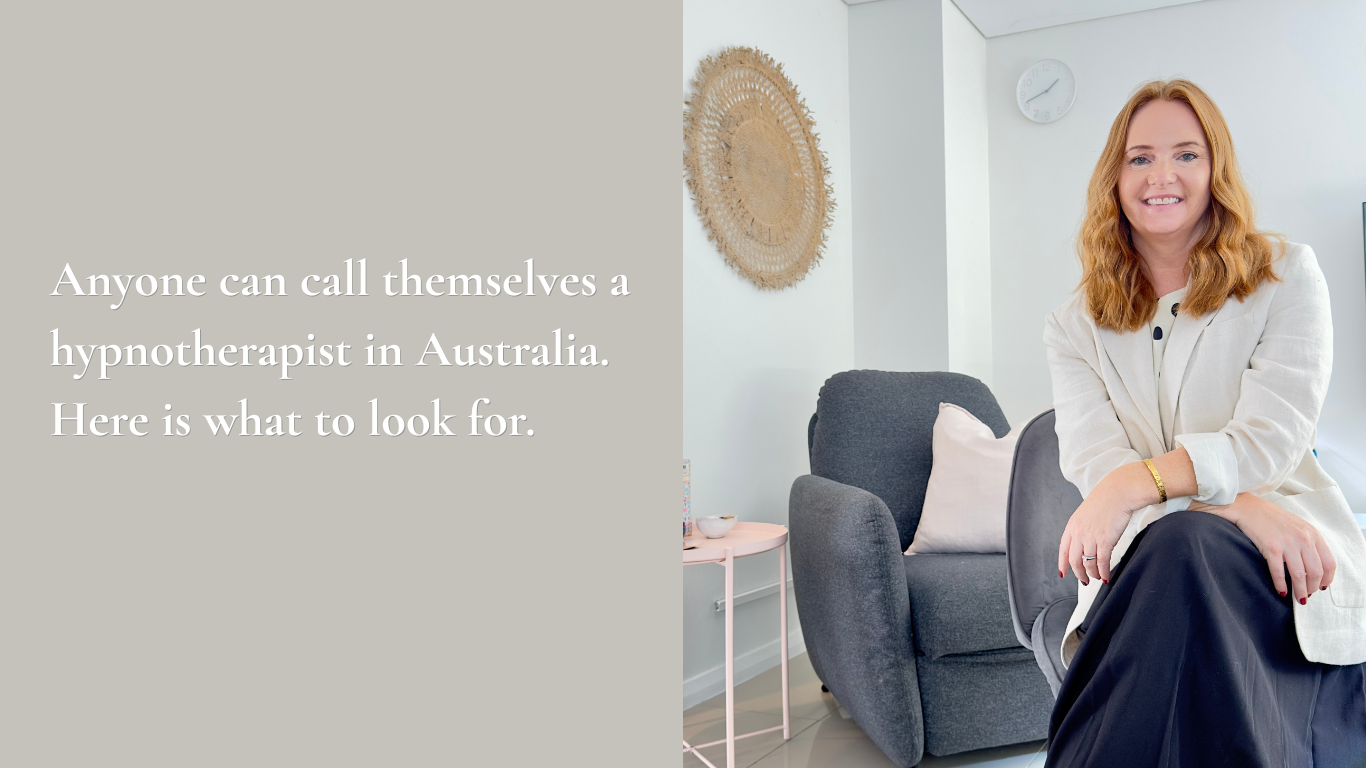
Here is something not many practitioners say upfront: in Australia, anyone can call themselves a hypnotherapist or a clinical hypnotherapist. There is no government body, no licence, no register you are required to be on before you open a practice and start seeing clients. I am not sharing this to alarm you. The person she saw may well have been caring and well-intentioned. But without a government-accredited qualification, there is no way to know from a website whether someone holds the highest level of clinical qualification available in this field or completed a short course. The two can look identical online.
This post is about giving you the questions that cut through that.
What "unregulated" actually means
In regulated health professions like psychology, physiotherapy, or medicine, practitioners must hold registration with AHPRA, the government body that sets and enforces the standards. If a registered psychologist breaches their code of conduct, they can be investigated and lose the right to practise.
Hypnotherapy sits outside AHPRA entirely. Someone could finish an online course on a Friday and open a hypnotherapy practice on Monday. No one is checking their training hours, their supervised clinical experience, or whether they hold insurance.
That said, unregulated does not mean there are no standards. The industry operates under a model of voluntary self-regulation, with its own professional hypnotherapy associations, its own code of ethics, and its own qualification benchmarks that sit in line with what you would expect from a regulated profession. The difference is that meeting those standards is a choice. A practitioner can choose to train to the highest qualification level available, join a professional hypnotherapy association, carry insurance, and commit to ongoing professional development. Or they can choose not to. Nobody is requiring them either way.
That is not a criticism of every practitioner outside the accredited system. It is simply the landscape, and it is why knowing what to look for matters.
What to look for when choosing a hypnotherapist
1. A government-accredited qualification
The qualification to look for in Australia is 10791NAT, the Government Accredited Certificate in Clinical Hypnotherapy and Strategic Psychotherapy. It sits under the Australian Qualifications Framework and requires completing a course through a registered training organisation, with supervised clinical hours, not just theory.
When you see 10791NAT listed after a practitioner's name, it means their training was assessed against a national standard. It is not a certificate they printed at home, and it is not something you can get in a weekend.
I am a Government Accredited Clinical Hypnotherapist and Strategic Psychotherapist (10791NAT), trained at the Institute of Applied Psychology under Gordon Young, one of Australia's most respected figures in Strategic Psychotherapy and Clinical Hypnosis.
2. Professional association membership
Reputable professional associations require members to hold recognised qualifications, carry professional indemnity insurance, and commit to a code of ethics and ongoing professional development. If a practitioner breaches those standards, the association has grounds to act.
Membership means the practitioner is accountable to a body beyond themselves. That matters.
I hold memberships with three professional associations:
ISPA (International Strategic Psychotherapy Association) — I am a Founding Member of ISPA, which brings together practitioners trained in Strategic Psychotherapy to uphold clinical and ethical standards in the field.
GOAH (Guild of Australian Hypnotherapists) — A professional body for qualified hypnotherapists in Australia, requiring members to meet training and ethical standards.
HCA (Hypnotherapy Council of Australia) — The peak body for hypnotherapy in Australia, recognised by state and federal governments, setting standards for training, ethics, and professional development.
3. Professional indemnity insurance and ongoing requirements
A qualified hypnotherapist should hold professional indemnity insurance. It protects you as a client if something goes wrong, and it signals that the practitioner is operating to a professional standard. But insurance is only one part of what maintaining professional membership actually requires.
To retain my memberships with ISPA, GOAH, and HCA, I am required to meet ongoing standards that include continuing professional development (CPD), regular clinical supervision, a current first aid certificate, and relevant background checks. These are not one-time boxes ticked at the point of joining. They are conditions I have to meet every year to remain a member in good standing.
This matters because it means the standard is maintained, not just established. If a practitioner cannot confirm they hold insurance and meet ongoing membership requirements, that is worth pausing on.
4. Transparency about their training and approach
Ask a qualified practitioner where they trained and what methods they use. They should be able to answer without hesitation.
In my practice I draw on a range of clinical approaches built on my training in Strategic Psychotherapy and Clinical Hypnosis, and deepened through ongoing professional development and supervision. That means I am not applying a fixed template. I am building the approach around what is actually happening for you.
I am happy to talk through all of this before you book. That is exactly what a discovery call is for.
5. A genuine discovery process before treatment
A practitioner who takes your booking without first understanding your history, your goals, and whether hypnotherapy is the right fit for your situation is skipping a step that matters. The first conversation should be about you, not the calendar.
A free discovery call is not a sales call. It is a chance for you to ask questions, for me to understand what is going on for you, and for us both to decide whether working together makes sense.
Questions worth asking before you book Hypnotherapy
What is your formal qualification in hypnotherapy, and where did you train?
Are you a member of any professional association, and what does that membership require?
Do you hold professional indemnity insurance?
What methods do you use and how will you tailor the approach to my situation?
Do you offer a discovery call or initial consultation before booking a full session?
A practitioner with genuine training and nothing to hide will answer these without flinching. If the answers are vague or defensive, that tells you something too.
Different does not mean wrong
Having a government-accredited qualification is a foundation, not a guarantee of the right fit. What practitioners do with their training, and which methods they use, varies considerably.
Some work in a more relaxed, suggestive style. Others, like me, use a clinical psychotherapeutic framework that looks at the pattern driving the problem, not just the symptom on the surface. Some practitioners work with one or two tools. Others bring a wider clinical range.
It is also worth understanding this when it comes to Medicare and private health. Psychologists are the practitioners most commonly covered by Medicare's Better Access scheme and by many private health funds, which can make them feel like the obvious starting point. But the majority of psychologists are not trained in clinical hypnosis. They are trained in evidence-based talking therapies, which help many people enormously. The question is whether that toolkit matches what you need. For anxiety, panic, and phobias in particular, clinical hypnosis works directly with the automatic nervous system response driving the problem, not just the thinking around it. Someone who has done twelve CBT sessions and still feels their body hijack them in certain situations is not failing at therapy. They may simply need a different door in.
The fact that something is covered by Medicare does not mean it is the right fit. And the fact that hypnotherapy sits outside Medicare does not mean it is less effective. It means the funding systems have not kept pace with the evidence.
The woman from that discovery call had not had a bad experience in the traditional sense. She had just spent months working with someone whose training and tools were not matched to what she was dealing with. There is a real difference between a practitioner who could not help you and one who simply was not the right person for this particular problem.
Why I am telling you this
I am rarely someone's first call. Many of the people who come to see me have already tried a psychologist, a counsellor, another hypnotherapist, sometimes all three. They are not starting from zero. They are starting from tired.
I am not writing this to put anyone down. What I am saying is that your mental health, your time, and your money deserve more than a guess. Ask the questions. Expect clear answers. And if something does not feel right in a discovery call, trust that.
If you are looking for a hypnotherapist in Sydney or would prefer to work online from anywhere in Australia, I would love to talk. You might also find it helpful to read Can Hypnotherapy Help With Panic Attacks? or Does Hypnotherapy Work for Anxiety? if you want to understand more about how the approach works before reaching out.
Claire Addis is a Government Accredited Clinical Hypnotherapist and Strategic Psychotherapist (10791NAT), Founding Member of ISPA, and member of GOAH and HCA. She is a registered clinical hypnotherapist practising in Waverley, near Bondi Junction, Sydney, and online across Australia.